How to Choose the Right Live Music for Your Corporate Event
When someone first contacts me about performing the violin at a corporate event, they often expect our conversation to begin with music.
Instead, I usually begin with a very different question.
How do you want your guests to feel when they leave?
It is not the question most people expect.
Quite understandably, organisers often assume our first conversation will be about practicalities. Should the performance be acoustic or amplified? How long should the music last? Would classical repertoire work best, or would something more contemporary feel more appropriate?
Those are all important decisions, but I have found they become much easier once we understand something more fundamental.
Every corporate event is trying to achieve something beyond simply bringing people together in the same room.
Sometimes that purpose is obvious. A business may be celebrating an important milestone, launching a new product or thanking clients for their support. More often, however, the objective is less tangible. You may want guests to feel welcomed from the moment they arrive, encourage conversations between people who have never met before or create an evening that reflects the values and personality of your organisation. Whatever the occasion, the experience people take home with them begins long before the first guest arrives. It is shaped by dozens of thoughtful decisions, each contributing to how the event is experienced as a whole.
Music is only one part of that process, but it occupies a rather unusual role because it has the ability to accompany an event as it unfolds. On its own, it cannot define an event but equally, it should never be treated as an afterthought. Like the venue, the food, the lighting and the hospitality, it contributes to the way an occasion is experienced and, ultimately, remembered.
Choosing the right live music is therefore not simply about choosing what people will hear, but about choosing the part music will play in the wider story of the event.
Every Corporate Event Has Its Own Personality
People often talk about corporate events as though they all follow the same formula, but in reality they are remarkably different.
A drinks reception celebrating the completion of a major project has a very different character from a networking event designed to introduce new business relationships. A healthcare conference carries a different sense of purpose from a gallery opening or new product launch. On paper, they may all appear under the same heading of "corporate event", yet each one asks something different of its guests.
That is why I have never believed there is a single formula for live music.
The question is not, "What music works best at corporate events?" but rather, "What kind of event are we creating?"
I find this distinction important because it changes the conversation entirely. Rather than thinking about genres or individual pieces of music, we begin by thinking about people. Who will be in the room? What is bringing them together? What sort of conversations do you hope they will have? How should the evening evolve as guests arrive, settle into the space and begin interacting with one another?
The answers to those questions shape every musical decision that follows.
Music Is Another Expression of Your Brand
Every organisation communicates something about itself whenever it brings people together.
Some companies are naturally formal, others deliberately relaxed. Some are traditional, whilst others pride themselves on innovation and creativity. Those qualities are often expressed through branding, presentations and speeches, but they are also communicated in more subtle ways that guests may never consciously notice, such as the music chosen for a corporate event.
Perhaps that is one of the reasons live music continues to play such an important role at corporate events. At its best, it is not there to become the centre of attention, but to help everyone else feel comfortable and focus on what really matters.
Why the Violin Is Such a Natural Choice for Corporate Events
Once we have established the purpose of the event, the conversation usually turns to the music itself.
Not every instrument works equally well in a corporate setting, and the reasons extend well beyond musical style.
One of the violin's greatest strengths is its adaptability. It can feel equally at home in a contemporary office, a hotel ballroom, a historic building, a gallery or a healthcare environment. The way music responds to different environments is something I explore further in The Role of Music in Gallery and Exhibition Spaces, where I reflect on how performance can shape the experience of moving through a cultural setting.
The violin can be performed acoustically where the space allows, or with discreet amplification in larger venues, making it suitable for everything from intimate networking receptions to conferences and awards evenings.
There is also a practical advantage that is easy to overlook. Unlike a piano, which depends entirely on the venue and occupies a permanent position within the room, the violin asks very little of the space around it. It requires no stage, no specialist transport and very little room to perform. As an event develops, the music can move naturally with it. Guests may be welcomed as they arrive, enjoy live music during a drinks reception and then transition seamlessly into the next part of the programme without the logistics becoming part of the organiser's concerns.
That flexibility is one of the reasons the violin has remained such a popular choice for corporate events. It is expressive without becoming overpowering, visually elegant without demanding attention and versatile enough to move comfortably between classical repertoire, jazz standards, film music and contemporary arrangements. The instrument adapts to the event, rather than asking the event to adapt to it.
The Performance Begins Long Before the First Note
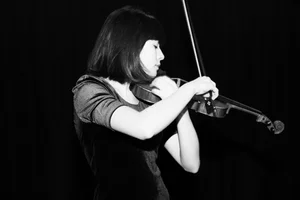
People often imagine that my role as a professional violinist begins when I lift the violin to my shoulder.
In reality, the performance starts much earlier and, in fact, some of the most important work happens before a single note is played. Preparation before the event includes conversations with the organiser to understand the audience, who will be attending and the structure of the event. We discuss where the music should sit within the programme, how visible, or understated, it should feel and think carefully about the repertoire. Where appropriate, I also visit the venue beforehand and always arrive in good time to become familiar with the space before guests begin to arrive.
When preparation has been well executed, the music feels as though it belongs naturally within the occasion and guests are free to enjoy the event without ever thinking about the planning that made it possible.
I experienced this particularly clearly during a performance for The Royal Free London NHS Foundation Trust.
The organisers wanted the event to feel welcoming and approachable whilst recognising the professional nature of the occasion. Rather than simply asking for "some classical music", we spent time discussing the audience, the flow of the evening and the balance between listening and conversation. Together we settled on a programme that moved between Mozart, Haydn and Boccherini before introducing jazz standards, blues and ragtime as the evening evolved.
Looking back, I don't remember that performance because of any individual piece I played, but because every musical decision had a reason behind it.
If you're interested in how live performance influences the experience of professional events from the guest's perspective, you may also enjoy my article How Live Violin Music Shapes the Atmosphere of a Corporate Event.
Choosing a Musician Means Choosing a Partner
When organisations book musicians for live music, they are not simply booking a performance.
They are inviting another professional into the team responsible for delivering the event.
That relationship depends on trust. It means knowing the musician will arrive in good time, communicate clearly with the venue, adapt calmly if timings change and work comfortably alongside everyone else involved in the event. Most corporate events involve dozens of people whose work overlaps without guests ever noticing. Venue staff, event organisers, catering teams, technicians and speakers each contribute to an experience that feels seamless.
A musician should become part of that collaboration.
The goal is never to draw attention to the logistics behind the scenes. Quite the opposite. The best compliment I can receive as a violinist performing at corporate events is not that the performance was impressive, but that it felt as though the music belonged there all along.
Choosing the Right Live Music
People sometimes ask me which music works best at a corporate event. There isn't a single answer because there isn't a single type of corporate event. The right choice depends on the people in the room, the purpose of the gathering and, perhaps most importantly, the feeling you hope guests will take away with them afterwards.
That is why I always return to the same question:
How do you want your guests to feel when they leave?
Everything else, from the repertoire to the way the performance unfolds during the evening, grows naturally from the answer.
The Right Music Should Feel Inevitable
After years of performing at corporate events, I have come to understand that the most successful performances are often those that become completely woven into the experience of the event.
Guests feel at ease from the moment they arrive and conversations begin naturally. The transition from one part to the next feels effortless and people linger a little longer because the environment encourages them to do so. Guests should leave remembering an experience that felt welcoming, generous, engaging and thoughtfully put together. If the music has helped create that experience, then it has fulfilled its purpose.
Ironically, this means that the best live violin performances are not always the most noticeable. When people reflect on the evening afterwards, they may well mention the venue, the food, the conversations they had, the presentations they heard and, yes, the music they enjoyed. Yet what they are really describing is something much harder to define, which is how the event made them feel.
That is why I believe choosing live music is ultimately an exercise in understanding people rather than simply selecting repertoire.
If you're still deciding between live music and recorded music, you may also enjoy Is Live Music Better Than a Playlist for an Event?
Live Violin for Corporate Events in London
I provide live violin performances for corporate receptions, networking events, conferences, healthcare organisations, brand launches, awards evenings and business events across London and the United Kingdom.
Every performance is shaped around the people, the purpose of the occasion and the experience you hope your guests will remember, ensuring the music feels like a natural part of the event rather than simply another item on the programme.
If you're planning a conference, networking reception, awards evening, healthcare event or brand launch, you can learn more about my live violin performances for corporate events here: